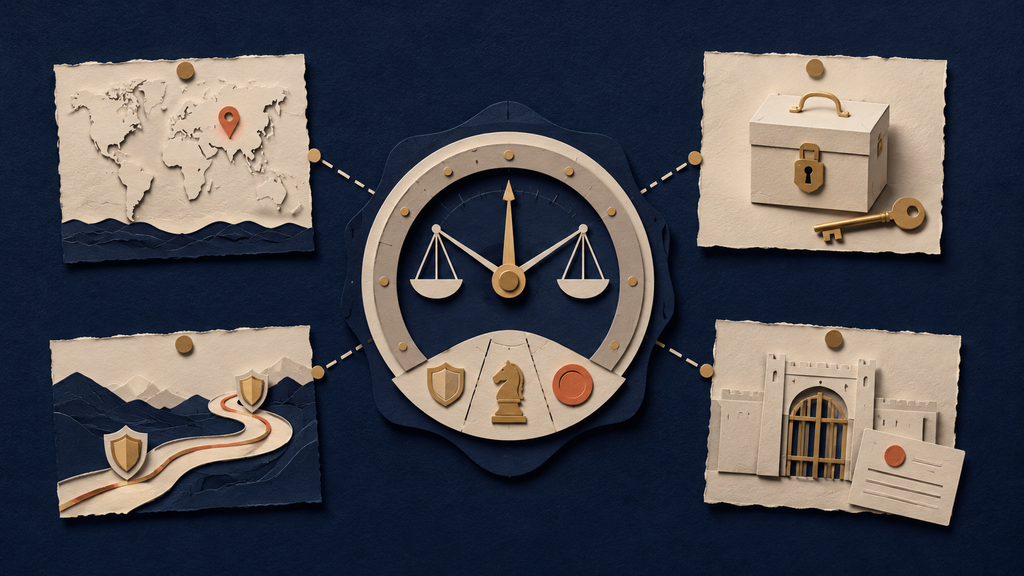
Part 4 of four. Each briefing in this series takes one of the four sovereignty questions from our full guide, Making Sense of Sovereign AI, and makes it usable on its own.
Question 4: Who Can Access – or Be Forced to Access – Your Data, Models, and Systems?
What this actually means
If Questions 1–3 are about where your data lives and how it moves, Question 4 is about something even more decisive:
Who has power over it.
“Access” is the human, organizational, and legal layer of sovereignty. It includes:
- Who inside your company can view, copy, change, or export data and models
(admins, engineers, data scientists, security teams) - Who outside your company can reach into your environment
(cloud provider support, SaaS vendors, outsourcing partners, systems integrators, subcontractors) - Who can compel those parties—or you—to provide access
(courts, regulators, national security authorities, sector supervisors)
This is where sovereign strategies often become fragile, because access is spread across:
- identity systems
- privileged admin accounts
- support escalation procedures
- vendor contracts
- and practical reality (“we needed the vendor to fix it fast”)
In other words: you may have strong data residency, encryption, and secure transport – and still lose sovereignty if the wrong people can see or extract the crown jewels.
Why leaders should care
From a compliance perspective, access is where regulators go first. They expect:
- role-based permissions (who can do what)
- least privilege (only what’s necessary)
- logging and audit trails (what happened, when, by whom)
- strong controls for third-party access (vendors and outsourcers)
From a choice perspective, access is where strategic sovereignty becomes real. Many organizations go beyond compliance because they don’t just fear data breaches—they fear something subtler:
- loss of proprietary know-how
- leakage of domain-specific models
- vendor dependency that erodes bargaining power
- future litigation or acquisition scenarios where control becomes contested
From a cost perspective, limiting access is expensive because it often means:
- keeping more capability in-house
- narrowing vendor roles
- implementing stronger governance, approvals, and monitoring
- accepting slower delivery and slower incident response
That’s why access control is not “security hygiene.” It is a leadership decision about where you want power to sit.
A more vivid, end-to-end example
The Vendor Who “Only Helps” – Until They Don’t
Imagine a global manufacturing company rolling out AI to optimize production lines.
The business goal is clear: reduce downtime, increase yield, and predict maintenance issues before they cause expensive stoppages.
1. The fast path: outsourcing access for speed
To accelerate delivery, the company partners with a specialist AI vendor.
The vendor proposes a solution that sounds perfectly reasonable:
- “We’ll connect to your sensor data”
- “We’ll train predictive models”
- “We’ll deploy dashboards and alerts”
- “We’ll support the system 24/7”
To make this work smoothly, the vendor receives:
- access to the production data lake
- access to model training environments
- admin privileges to deploy and troubleshoot pipelines
The project moves quickly. Results are good. Leadership is pleased.
2. The sovereignty question appears late
After a year, the company notices something:
The models don’t just predict equipment failure.
They encode the company’s unique production patterns – how it tunes machines, manages yield, and sequences operations.
This is operational IP.
Now leadership asks the uncomfortable question:
“If the vendor can see and export the models, what exactly are we giving away?”
The contract says the manufacturer owns the final models.
But in practice:
- vendor engineers have seen the data
- the vendor has copies of training pipelines
- model weights may be stored in vendor-managed systems for “support”
- vendor teams may reuse patterns across clients as “benchmarks” or “industry accelerators”
Nothing here is necessarily malicious. But sovereignty is not about intent – it’s about control.
3. The trigger event: why access becomes urgent
Then something changes.
Maybe the vendor is acquired by a competitor.
Maybe a subcontractor is added quietly to support the account.
Maybe a regulator asks how model decisions are made.
Maybe a legal dispute emerges and discovery requests expand.
Suddenly, leadership realizes:
Access is not just “who logs in today.” It is who could be forced or incentivized to reveal information tomorrow.
The vendor may be compelled under its own jurisdiction.
Or the vendor may have internal staff turnover and governance gaps.
Or a support escalation process may allow “break glass” access by provider engineers.
The sovereignty risk wasn’t the AI model itself.
It was the access relationships around it.
4. The deliberate redesign: sovereignty through controlled access
In the next iteration, the manufacturer changes its approach for its most strategic plants:
- Model training occurs only in an environment the manufacturer controls
- The vendor brings expertise and tools, but cannot move raw data outside
- Vendor access is time-boxed, tightly scoped, and heavily audited
- Model artifacts cannot be exported without explicit approval
- Critical admin roles are kept in-house and locally contracted
The vendor can still contribute. But the sovereignty boundary is now explicit.
5. The cost trade-off becomes real
This setup is slower and more expensive:
- more internal platform work
- more governance
- fewer “quick fixes” by external admins
- more burden on internal security and operations
But leadership accepts it where it matters – because these plants are not just assets; they are the foundation of competitive advantage.
For non-critical plants, the company keeps the faster model with looser access controls.
Again, sovereignty is placed, not maximized.
The practical insight for leaders
The key lesson is this:
- Sovereignty is not only about data and infrastructure
- It is about who holds power—technically, contractually, and legally
- Access is the easiest way for sovereignty to leak, because it often expands “temporarily” and then never shrinks
For business leaders, the right question is not:
“Do we trust this vendor?”
But:
“If circumstances change—acquisition, regulation, dispute, government request—who could access our data and models, and what could they do with it?”
That question forces clarity on:
- privileged access roles
- vendor support processes
- subcontractors
- auditability
- export controls for models and artifacts
And it turns sovereignty into what it should be: a deliberate operating model decision, aligned with the business value at stake.
That completes the four questions. For how to put them to work — the leadership pre-mortem, sovereignty tiers, and making the cost explicit — return to the full guide: Making Sense of Sovereign AI.