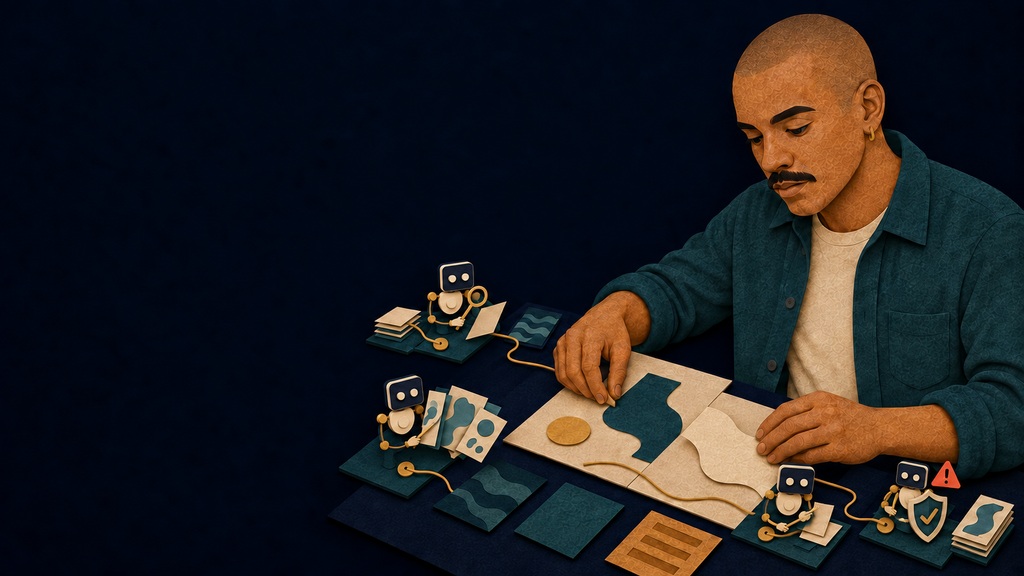
In brief: Agents make creative options nearly free, which does not remove the Creator's constraint so much as move it: two hundred and forty variants are usually four ideas in sixty costumes, and the scarce thing becomes a person willing to choose one and answer for everything that went into it. This briefing is for designers, researchers, data scientists and product storytellers, and for the leaders who review their work. It covers the three things agents actually change — free options, unowned rights, and a design space that is no longer rigid — plus the evidence map that decides what the firm may use, and the habit that keeps a team's credibility: show the process, not only the result.
An agent can generate two hundred versions of anything. It cannot tell you which one is right, and it cannot answer for what went into making it. This briefing follows one campaign through a Creator’s hands: what a studio of agents genuinely accelerates, what it quietly puts at risk, and why the rights question arrives before the taste question.
Luca Behrens has four days and a service problem. Bruns & Lehmann — the firm this Path follows, a family-owned Mittelstand manufacturer of dosing pumps in northern Germany, around 420 people, customers across Europe — makes most of its margin after the sale, on service contracts and spare parts. And service is where customers are unhappiest: a pump stops in a water-treatment plant at 3am, the plant’s technician calls a hotline that opens at seven, and a Bruns & Lehmann engineer drives four hours to discover a blocked valve the technician could have cleared alone.
The proposal is a guided troubleshooting experience for customer technicians: symptoms in, likely causes and safe next steps out, with a clean hand-off to a human engineer when the case is beyond it. On Friday the advisory board decides whether to fund it.
Which is the first thing agents changed here, before anyone designed anything. Two years ago, eleven technician interviews and a working prototype were the kind of thing you did after the money arrived — so boards funded slide decks and found out later what the users actually needed. Luca can afford to do the discovery first. His job on Friday is to make the value visible before it exists: a prototype the board can click, evidence from the eleven plant technicians his team interviewed, and a story connecting the two — why this flow, for these users, with this promise.
In the old arrangement this was six weeks and an agency. This time most of the first drafts come from agents he briefs himself, and he is optimistic: four days instead of six weeks, prototype by Tuesday, story by Thursday.
Do you think he will be faster?
By Wednesday he has two hundred and forty variants. Flow directions, interface treatments, three different framings of what the tool is even for — a manual that answers back, a diagnostic, or a way to keep a nervous technician calm at 3am. The work of choosing has not become smaller. It has become the whole job.
He and his agent studio did a smaller job last month that explains why anyone let him near this one. When the firm automated supplier-order intake — the project the Owner funded and the Organizer delivered — Luca designed what the person reviewing an uncertain order sees. Show a reviewer only a decision and an Approve button, and they will approve. One case every few seconds. Show them the order, what the agent read, why it stopped and what happens next, and they will catch the case that matters. Same automation. Entirely different control.
What a Creator actually holds
The Compass groups the delivery roles of a transformation as Transformers — people, not the neural-network architecture; the difference is exactly the accountability gap this series works. The Creator is the Transformer who turns intent into something a person can see and use: concepts, prototypes, interfaces, the words and images a customer meets first.
Creators are designers, data scientists, researchers and product storytellers. They turn strategy into something user-facing; they prototype so Buyers, Deciders and Influencers can see value before it exists; they stress-test assumptions with data and design, often catching flaws before launch; and they give the work its credibility with the people who use it.
What the role holds is harder to name than what it produces. Four things, and no agent holds any of them:
- Intent — what this is actually for.
- Taste — judgement about an audience, not a personal preference.
- Empathy — with the person on the other end, earned by having spoken to them.
- Answerability — for what went into the work: whose material, whose likeness, whose data, and whether any of it was ours to use. Most organisations discover this duty only when it fails.
What agents change for this role
Options become nearly free. That single change hits this role harder than any other: the old constraint — how many directions can we afford to explore — is gone, and what replaces it is the Creator’s own attention.
The failure mode follows directly: more variants get mistaken for better strategy. Two hundred and forty options are not two hundred and forty ideas. They are usually four ideas in sixty costumes, and a team reviewing them in sequence picks the one it saw when it was freshest, not the one that serves the brief. The discipline that saves Luca is upstream: a brief sharp enough that most variants can be rejected quickly.
The second failure mode is quieter and more expensive. Rights, attribution and brand judgement go unowned — not through malice, but because nobody was asked to own them at the moment the material was generated. This briefing resolves that in two places: the evidence map below turns it into decisions a Creator makes before the first brief, and the checks at the end turn it into something a leader can ask about in a normal conversation. Ownership that is nobody’s habit has to become someone’s job.
A third change is easier to miss: the design space itself moved. Almost everything a Creator learned to design was rigid by necessity — fixed screens, fixed paths, the same content in the same order for every user, whoever they were and whatever they already knew. Software could not respond, so designers compensated with structure: forms, wizards, decision trees, question one, question two, question three. That constraint is gone. An interface can now adapt to the person, the situation and what was just said — a technician photographs the pump display or describes the noise into a phone at 3am, and the next question can come from that, or from a fixed list, or from both — the shape is now a choice rather than a given.
In my work, building my own AI-first tools, the hard part was never the tool. It was catching myself laying out step one, step two, step three out of pure habit — when the thing every user has always wanted, speak the problem and get a usable answer in seconds with their own specifics respected, had finally become buildable. What is possible also keeps moving: platforms add interaction options month by month, faster than any one person can track while doing their job. That is worth a standing brief in the studio — an agent whose only task is to report what has newly become designable.
One more change, and it is not a design problem. For a Creator who directs and chooses, agents are leverage. For the people whose craft is the making — the retoucher, the illustrator, the copywriter — the work that gets cheap is the work they trained for. The work they chose this career to do. The reason they are in the room at all. Saying their role “shifts to direction” is half true at best: directing a creative agent studio is a different skill, learned differently. And some will not want the new job at all. They will leave — the ones with options first, which means the best of them. The leadership question is therefore wider than retraining: what else can be offered to someone hired for a talent the firm still needs, and where does the time the studio saves actually go — back into craft, or straight into more volume? Most organisations answer that second question by default, without noticing they were asked. It is taken up properly later in this Path. It belongs here because a briefing about Creators that skipped it would be pretending.
From one assistant to a Creator’s studio
Luca’s first agent was a research assistant: pull the technical specifications, summarise how competitors position comparable pumps, list the objections that come up in sales calls. Nobody built it for him. He set it up himself, in the assistant the firm already licenses — no ticket, no budget line, no engineer — because a Creator’s material is documents and images he already handles, so he gives them to it the way he would to a colleague. IT appeared later, once it was clearly useful, to give the agent a proper identity and decide what it may reach. That order is why Creators are so often a firm’s first real agent users.
As the project grew, separated purposes made sense:
- A research and synthesis agent — works the declared sources: the interview transcripts from the eleven plant technicians, the service desk’s call log showing what actually goes wrong and how often, the product specifications, the safety and maintenance documentation. It clusters what was actually said and cites who said it.
- A divergent-concepts agent — briefed to produce genuinely different directions rather than variations: three ideas of what the tool is for that a colleague would argue about, not thirty layouts that rhyme.
- Production agents — the ones that actually make things: draft copy in the house voice, generate or adapt visuals, build out interface states and variants. Usually several tools rather than one, and the place volume appears — this is where two hundred and forty variants come from.
- A prototype agent — turns a chosen direction into something the board can click and a plant technician can react to, fast enough that the reaction still changes the design.
- An accessibility and rights-risk prompt — raises the questions before publication rather than after: is the contrast usable on a phone in a badly lit plant room, is the language right for a stressed technician at 3am, and where did this image, phrase or interview quote come from.
- A consistency checker — reads the output against the house language and the visual rules, and flags where a claim has drifted beyond what the specifications support.
One warning about that last agent, from my own work: consistency is not a setting you switch on once. The same brand file handed to different tools produces different interpretations, so someone has to check the checker against the real brand on a cadence.
What is deliberately not on this list is a taste agent — something that scores the options and picks the winner. A model can tell you which variant resembles work that performed well before. It cannot tell you which is right for this customer, this year, this promise. Delegate the choice and the role stops existing, because choosing is what a Creator is for.
Cost note: six agents means six briefs to keep true — but the real cost is review capacity. Every agent that generates faster increases what one person must look at and decide, and that person was the constraint the studio was meant to relieve.
One more thing about briefs: Creators rarely work alone, and the moment two people brief their own private agents on the same project, the studio forks — two versions of the house language, two readings of the interviews. The brief belongs to the team, not to whoever wrote it first. Shared agents get their own briefing later in this Path.
Where a firm has no such tool at all, or a policy against connecting one to anything internal, the wall is real and the Organizer’s briefing takes it on properly — its five-step sequence for building the first agent works unchanged for a studio.
The Creator’s data and evidence map — where rights live
For most roles, the evidence map is about what an agent may read. For the Creator it is also about what the organisation may use, and “material” here means more than images and copy: interview recordings, user feedback, usage and service data, market information, the datasets a data scientist trains or tests on, and the brand assets themselves. That makes it the role’s most consequential document.
Sources that may be read. The declared list: own specifications and imagery, the firm’s own research and service data, licensed stock and datasets with their licence terms attached, standards documents the firm has bought, and competitor information from genuinely public sources. Everything else is inspiration a human looked at, not material an agent may work from.
Each project brings its own sources, and those are the ones a general policy forgets: designing order intake means reading real supplier correspondence; designing the service tool means reading past service requests and engineers’ on-site notes. Declare them per project, not once for the firm — and note that they usually hold the most personal data.
Material that never enters. Competitor creative and anything scraped from behind a login, unlicensed imagery or datasets, customer photographs and site footage without written permission, personal data pulled from support or service systems without a basis for this use, and anything containing an identifiable person who did not agree to it. Research material deserves its own line: the eleven technicians agreed to be interviewed about their work, which is not the same as agreeing that their words, names and recordings sit in a system indefinitely. They are also customers’ employees, which makes the promise you made in that plant room a commitment your firm has to keep. What was promised in the room is the boundary. Decide the list before the first brief, because the expensive version of this decision is made after publication. Firms of this size do make these decisions deliberately. InVIDO, a German custom-furniture manufacturer, built its knowledge assistant so that answers had to be bound to the documents the firm supplied rather than to the model’s general knowledge, had the people who knew the material assess answer quality themselves, and required self-hosting because sensitive company data was not going to an external cloud provider (Mittelstand-Digital Zentrum Chemnitz, 2026 — a prototype, built to decide whether the long-term investment is justified). None of those three decisions needed an engineer. All of them needed someone to insist.
Provenance, recorded as you go. For every asset that ships: where it came from, what generated it, what licence covers it. This is unglamorous and it is the only thing that answers a challenge six months later — and a challenge is precisely when nobody remembers.
Disclosure. European rules on marking AI-generated content are tightening, and whether a given obligation applies to your case is a question for your own counsel. The practical position is simpler: decide your disclosure practice, write it down, apply it consistently. A rule you chose is defensible; an inconsistent habit is not.
The questions that travel
Four questions Luca asks of his own studio, and of any agency or supplier presenting an AI-assisted process.
- What did this draw on, and may we use it? A good answer names sources and licences: our specifications, our photography, this stock library under this licence. “The model just knows our style” is not an answer.
- Who chose, and on what grounds? There should be a person and a reason: we took this framing because the call log says technicians ring before they read. A choice nobody can explain is a choice nobody made.
- What do we say if a customer asks whether this was made with AI? Decide before you are asked, in writing, and apply it the same way every time.
- What here could we not defend? Every studio produces something awkward to explain — an unclear image origin, a claim beyond the specification. Find it before publication. That is what the review is for.
Show the work
In my work I have owned several tool-creation projects built with AI, and one habit separates the teams that keep their credibility from the teams that lose it: they show the process, not only the result. A vigilant reviewer can tell within seconds whether something was thrown together with AI or made carefully with it — and when they cannot tell, they assume the worse of the two.
The remedy is unglamorous and it works. Open the design presentation with the process, before the first visual: what was generated, what was rejected and why, what was made by hand and why that was the right call. This is the same trust problem the Owner has with a too-polished pack, arriving from the other side. The organisation asked you to use AI to go faster, and then withholds trust unless your own reasoning is visible in the result — and design work loses its perceived value quickly once the craft becomes invisible. Showing where AI genuinely helped, and where it did not, is how a Creator keeps the judgement attached to the person who exercised it.
If the Creator is on your team
Half the readers of this briefing make things. The other half lead someone who does, and that job is not art direction. It is checking that speed has not replaced judgement. Three checks do most of the work.
- Ask for the brief, not the options. A thin brief with many options means the team is generating instead of deciding, and no volume of variants fixes a brief that never said what the work is for.
- Ask where the material came from. Once, early, in a normal conversation. Teams that can answer immediately have a provenance practice; teams that go quiet have a liability, and it is cheaper to find out now.
- Watch what stops being discussed. When reviews are about which version rather than whether this is the right approach, the studio is steering and the humans are picking.
Leading people who work with agents — the checks, the warning signs, the review cadence, for all six roles — is covered in its own briefing later in this Path.
Four days, one decision
On Thursday, Luca shows the board one prototype. Three of the two hundred and forty variants survived into it.
He walks them through the 3am path. The first screen asks what the technician can see and hear, not which model the pump is. The hand-off to a human engineer is one tap away, not buried. Under each design decision sit the technicians’ own words about what they need when a plant is down.
Every claim traces back to the specifications. The imagery is the firm’s own, or licensed with the licence on file. The quotes are used the way the eleven were told they would be. And Luca can say who chose this direction and why, in one sentence, without checking.
So: was he faster? Yes — days rather than weeks, and the answer would be the same at ten times the volume. But the time did not come off the work; it moved. What used to be six weeks of producing became four days of deciding, and the day he loses is the day he spends choosing badly among two hundred and forty things that all look finished.
That is the Creator’s version of the series’ claim. Agents made the options nearly free, which sounds like the end of the constraint and is really its relocation: the scarce thing is now a person willing to say this one, for this reason, and to answer for everything that went into it.
The board says yes on Friday. What Luca hands over is a prototype, eleven interviews, a decision about what the tool is for, and one line in the design that will cost the next three roles real work: when the system is unsure, it stops and says so. The Implementer has to build that hesitation, the Tester has to prove it happens when it should, and the Maintainer has to keep it true after the model behind it changes. The next three briefings in this Path follow this system through their hands.
Related reading
- The AI-Enabled Teams Path — all fourteen briefings in reading order; previous: the Organizer, on the order-intake project; next: the Implementer, building the service system designed here.
- One Agent, a Suite, or an Agentic Workflow? — the three shapes, and why a studio is a suite rather than a lane.
- Before You Upload: The Data Category Protocol — what may be given to an agent, decided by category rather than case by case.