Revision note — 6 September 2026: The Klarna example was updated to distinguish its high-volume support results from the 2025 reintroduction of human support for complex and premium cases. Forbes, May 2025
Artificial Intelligence, automation, and new digital operating models can feel overwhelming. Tools emerge daily, vendors pitch shiny promises, and the people responsible for the decision are left asking: Where do I even start?
The answer lies in the Transformable Process — the specific, painful process you choose to transform.
In the PathPatron Compass, as the second step in Process Pillar you are zooming into the nitty-gritty:
- Total Value Transformation shows where value lies across the journey.
- Transformable Process shows which workflow pain to solve first.
- Transformation Journey shows how you take the organization there.
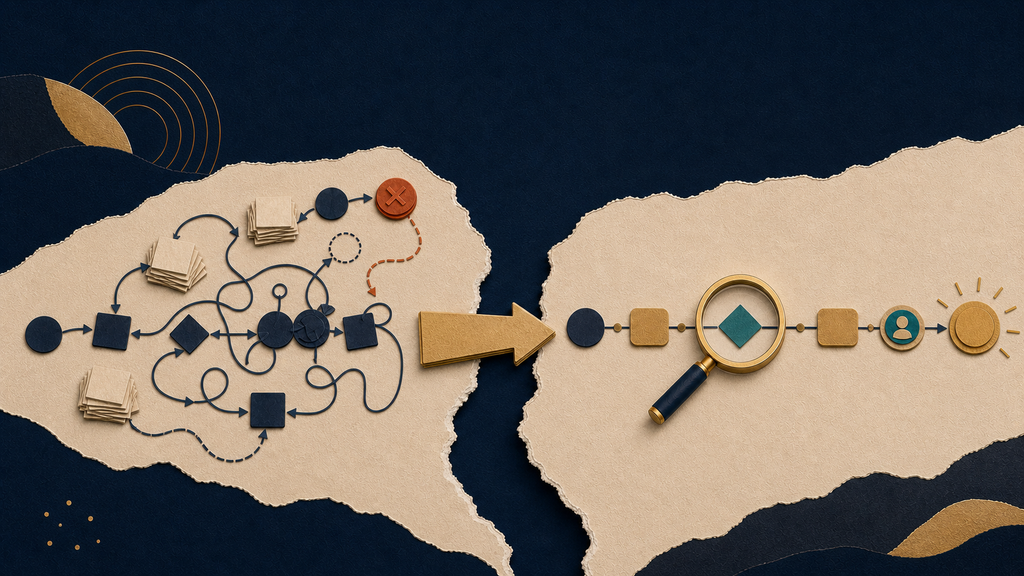
Think of it as moving from:
👉 Pain-ful state: repetitive tasks, bottlenecks, poor experience.
👉 Pain-free state: automation, personalization, smoother flows.
💡 Decision-maker takeaway: Transformation starts with a specific process, not with technology hype.
🌍 Case Examples: Real Transformable Processes
| Company | Painful Process | Pain-Free State | Outcome |
|---|---|---|---|
| Unilever (2025) | Supply chain planning full of manual spreadsheets | AI demand sensing + automation | Faster forecasts, sustainability gains, exec trust Unilever, Aug 2025 |
| IKEA (2024) | Customers frustrated with generic design journeys | AI-powered personalization for room planning | Higher conversions, stronger brand loyalty Retail TouchPoints, Jan 2024 |
| Klarna (2024–2025) | Support tickets overloaded agents | AI assistant handling 2.3M chats in month one, with human escalation for complex cases | Volume and cost gains required a later quality correction — a reminder to design the escalation route from the start. Klarna, Feb 2024 |
💡 Decision-maker takeaway: Each success began with one specific process pain point.
🧩 Scenarios: Choosing the Right Transformable Process
- User Pain → Buyer ROI Conflict
- Scenario: Users want AI onboarding help, but Buyers only care about churn reduction.
- Technique: Use ROI modeling templates (Power Pillar) to translate user delight into Buyer metrics.
- 💡 Decision-maker takeaway: Always link user benefit to Buyer ROI.
- Transformer Overload Risk
- Scenario: Engineers resist a new automation project due to technical debt fears.
- Technique: Run a Pre-Mortem Workshop to surface and mitigate risks before the pitch.
- 💡 Decision-maker takeaway: Respect Transformer bandwidth — or lose execution momentum.
- Decider Strategic Lens
- Scenario: The COO asks: “Will this still differentiate us in 5 years?”
- Technique: Use Scenario Mapping (Power Pillar: Techniques) to show resilience under future shifts.
- 💡 Decision-maker takeaway: Deciders care about future-proofing, not today’s novelty.
🛠️ Step-by-Step Guide: Mapping a Transformable Process
Here’s a repeatable framework leaders and transformation owners can use as working prompts when they map a process.
Step 1. Identify the Pain
- Interview users, frontline teams, and support staff.
- Collect friction points: where time, money, or trust is lost.
Step 2. Define the Pain-Free State
- Envision the “dream flow” — what does seamless look like?
- Involve both users (“what feels effortless?”) and transformers (“what’s technically possible?”).
Step 3. Map Stakeholder Impacts
- Link pain and relief to each role:
- Users → better experience.
- Buyers → ROI.
- Deciders → strategy + future-proof.
- Influencers → advocacy or pushback.
- Transformers → execution load.
Step 4. Prioritize the Process
- Score candidate processes by:
- Pain severity.
- Ease of transformation.
- Strategic alignment.
Step 5. Explore Solution Options
- Look at Power Pillar (Tech, Tools, Techniques):
- Could automation solve this?
- Could AI add personalization or prediction?
- Which tools fit governance rules?
Step 6. Build the Pilot Case
- Draft a one-pager: pain, pain-free state, metrics, risks, and “ask.”
- Include Transformer input so feasibility isn’t questioned.
Step 7. Test, Measure, Iterate
- Run the pilot → measure against pain-free goals.
- Share wins fast, even if partial.
Step 8. Scale & Sustain
- Once proven, scale step by step.
- Hand off maintenance plans to Transformers.
- Document governance and feedback loops.
💡 Decision-maker watch-out: Scaling without Maintainers’ buy-in = burnout + breakdown.
🔗 How Transformable Processes Tie Across the Compass
Transformable Processes don’t live in isolation — they are the meeting ground where People dynamics and Power tools collide. Every pain point you choose to transform echoes across the Compass:
👥 People Pillar: The Human Ripple
- Users → Define the pain. If the process doesn’t feel broken to them, you’ll struggle to prove adoption value.
- Buyers → Fund the solution. They don’t pay for “automation” — they pay for churn reduction, efficiency, or revenue lift.
- Deciders → Judge the strategic fit. Even a perfectly pain-free flow won’t scale if it doesn’t align with long-term bets.
- Influencers → Shape momentum. A skeptical data lead or compliance officer can slow you down long before you reach the Decider.
- Transformers → Deliver execution. Their bandwidth and credibility determine whether a “yes” becomes reality.
💡 Decision-maker takeaway: Choosing the wrong process to transform doesn’t just waste time — it can erode trust with every other role in the Compass.
⚡ Power Pillar: The Tools & Techniques Lens
- Automation → Streamlines workflows but may face resistance from Transformers (e.g., “technical debt risk”).
- AI → Personalizes or predicts, but raises trust questions for Users, and compliance alarms for Influencers.
- Analytics & ROI modeling → Convince Buyers, but only if you tie outputs to their value currency (cost savings, revenue growth).
- Techniques like pre-mortems, prioritization matrices, and scenario mapping → Help decision-makers turn abstract tech into credible, stakeholder-ready plans.
💡 Decision-maker takeaway: The process you choose to transform is also how you decide which tool matters most. Power without process is noise.
🧭 The Compass Connection
- Every People role filters the process differently.
- Every Power tool only adds value when applied to the right pain point.
- The Transformable Process is where these perspectives converge — it’s the anchor point of the Compass.
💡 Decision-maker takeaway: Your success as the person responsible for the decision isn’t judged by knowing every tool or pleasing every stakeholder. It’s judged by whether you can spot the right process to transform, and then marshal People + Power around it.