PathPatron Use-Case Canvas series — 1 of 7
AI-assisted PathPatron illustration, developed under human art direction.
On Thursday afternoon, Maya receives the message she has learned to dread: Can you tell us whether the supplier will be ready for Monday?
She is the project lead for a programme that cannot start without the supplier. Procurement says the documents were requested. Legal says the contract packet is incomplete. Finance has flagged the bank details. The supplier has received several emails but cannot tell which request matters. Maya has no single status to report and no confidence that a quick answer will still be true tomorrow.
Someone in the steering group has an obvious suggestion: “Couldn’t we use AI to fix supplier onboarding?”
Maya does not reject the question. She just refuses to answer it first.
Before she asks a tool to summarise anything, before she books a workshop and before the team turns a late supplier into a new automation project, she needs to know what actually happened. Whose work is being delayed? Which check protects the organisation? Who is allowed to decide when speed and control collide? And is the useful intervention an AI assistant, a clearer intake, a different hand-off—or simply a named owner?
That is what the PathPatron Use-Case Canvas is for: one shared surface on which a team can turn a messy, real operating problem into a defensible next decision.
AI-assisted PathPatron illustration, developed under human art direction.
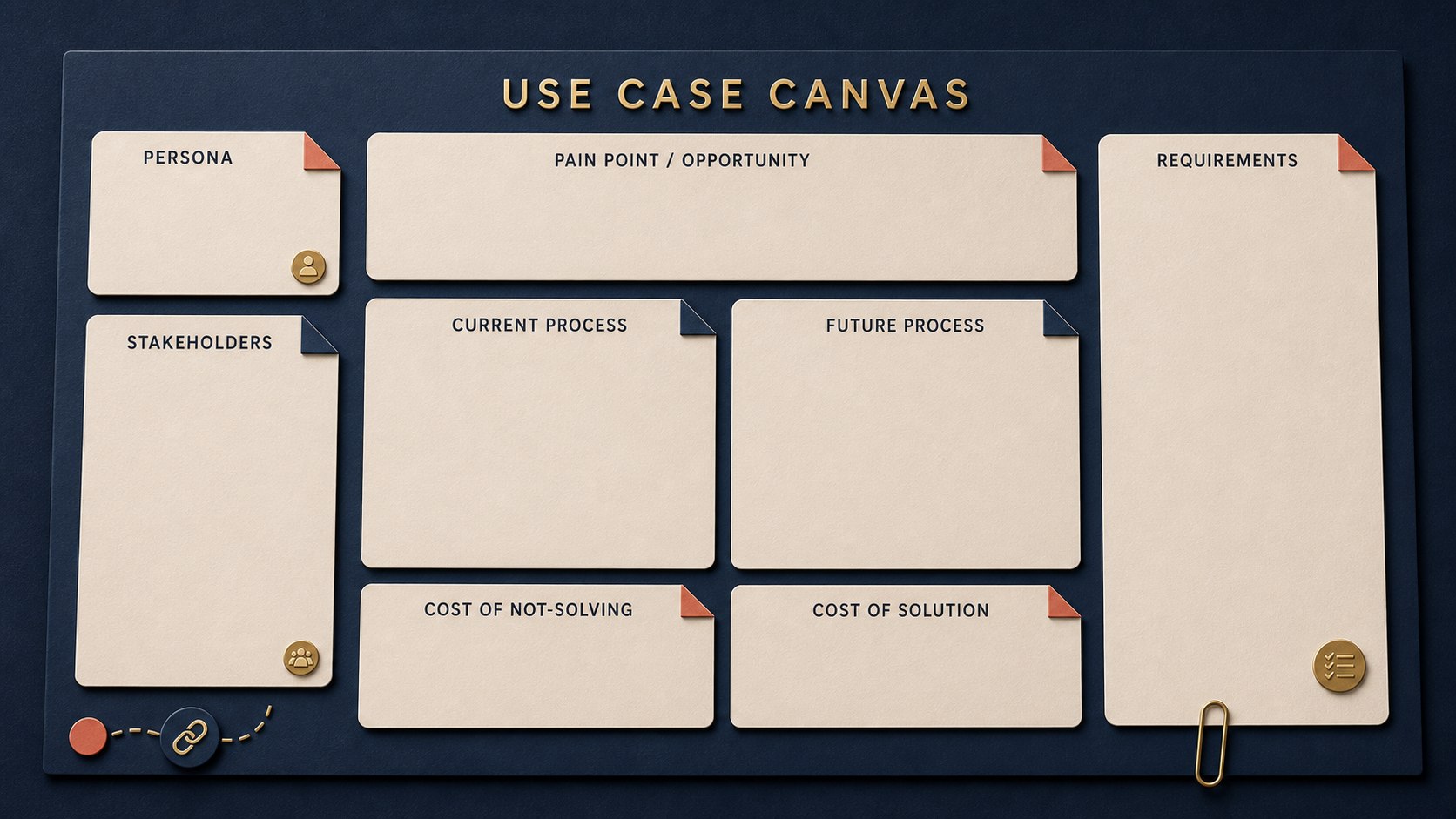
At the beginning, it stays blank. No field is highlighted and no sticky note pretends the team already knows the answer.
The Canvas is Maya’s running record of one case. It starts on the left with the person caught in the moment and the people around them. It then follows the work as it happens, makes the cost of delay visible, compares a credible change and ends with the requirements and controls a delivery team would need. The board is not completed from top to bottom in one sitting; each note is added when someone can support it with evidence or name it as an open question.
It also gives Maya one shared decision record she can use beyond the workshop: to present a finding to leadership, make the case for discovery funding, turn a use case into a business case, and work with technical leaders without pretending that a business-side problem statement is already a technical specification. The completed Canvas makes the hand-off between those conversations visible.
Where Maya starts: do not mistake a loud request for a shared problem
The person who says “we need an agent for supplier onboarding” may be seeing a genuine problem. They may also be seeing only the part of the work that is visible from their seat.
Maya treats the request as a useful signal, not a brief. She asks what happened in a real case, who else carries the consequence and what would become unacceptable if the workflow became faster. In this case, a faster follow-up is helpful; a faster route that presents incomplete evidence to Legal or creates a vendor with unchecked bank data is not.
That is why she begins with the latest real supplier case. It is recent enough for people to remember, concrete enough to verify and small enough to keep the first Canvas honest.
Do it yourself in an hour or less: Maya’s first pass
Maya opens a blank Canvas and collects the smallest useful evidence set: the original supplier request, the messages that followed, the date the project needed the supplier, the missing contract item and the bank-data validation result. She does not ask an AI assistant to diagnose the case. She uses an approved tool only to organise the notes she already has.
Her prompt is deliberately restrained:
Using only these anonymised notes, separate statements into Evidence, Hypothesis and Information gap. Do not invent causes, stakeholder motivations, control rules or solutions. List the five questions that a project team needs to answer before proposing a change, and identify which role could validate each answer.
The result is useful because it is unfinished. It shows Maya that “supplier onboarding is slow” is not evidence. What she does have is a small trail: a missing clause, a failed bank-data check, repeated status chases and a supplier who received conflicting requests. It also exposes the gaps: who owned the next action at each point, how often the pattern recurs and who can approve an exception.
The AI output is a preparation aid, not a finding. Maya keeps every suggested statement labelled as a hypothesis until a person who knows the work confirms it.
The one-hour solo version
If Maya is in a pinch, she can get to a non-validated first version in one focused hour. She is not replacing the people who carry the work. She is preparing a board that tells her exactly whom to bring together and what to ask them.
| Time | What Maya does herself | What goes on the board |
|---|---|---|
| 0–10 min | Gather the latest case trail: request, messages, timestamps, outcome and known checks. | A factual case note; sources; first information gaps. |
| 10–20 min | Ask the AI assistant to sort notes into Evidence, Hypothesis and Information gap. | A source-linked first draft. |
| 20–30 min | Think through who touched, delayed, approved, supplied evidence for or felt the consequence of the case. | Persona and provisional stakeholder notes. |
| 30–40 min | Replay the route from the available evidence—not from the policy diagram. | A rough current route and likely breakpoint. |
| 40–50 min | Let the assistant identify unanswered questions, contradictory claims and possible control boundaries. | First pain, need, cost and authority hypotheses. |
| 50–60 min | Name who needs to validate each material note and invite them to the first working session. | A validation list and a workshop invitation. |
The Canvas at this point should look usefully incomplete. Maya marks every uncertain note Hypothesis or Information gap. She has not produced a shared diagnosis; she has produced a better agenda for one.
An AI-first-pass when the people cannot meet yet
Maya can also make that preliminary version alone. She gathers anonymised source material—case emails, handover notes, ticket history, policy extracts and a short account from the coordinator—and asks an approved AI assistant to place only supported claims into the Canvas fields.
Using only the source material below, draft a non-validated Use-Case Canvas for this single workflow case. Quote or reference the source for every evidence claim. Put unsupported possibilities in a separate Hypothesis / information gap list. Do not invent metrics, stakeholder motivations, authority, legal rules or a solution. For each Canvas field, state which role must validate it. End with the five highest-value questions for a 30-minute human review.
This can be fully autonomous as a drafting task: the assistant can structure the evidence, show gaps and create a board that makes the human session faster. It cannot be autonomous as a decision task. Legal, Finance, the process owner and the people living with the work still validate the facts, boundaries and exception authority before anything changes.
That distinction is what makes the shortcut responsible. The AI is allowed to prepare the first pass; the people who carry consequence remain responsible for accepting it.
Then she brings the people who carry the work into the room
Maya then runs a short working session. In a room, she prints the Canvas at wall size. In a remote session, she uses the same image as a locked Mural or Miro background. Either way, the rule is the same: this is one board for one real case, not a generic process map for every supplier in the company.
Maya did not choose the group at random. Her solo pass showed who appears in the evidence trail: Procurement, Legal, Finance, the business owner and the supplier-facing coordinator. She also adds the process or control owner if the notes cannot establish who owns exceptions. Those are the people she needs to confirm, correct or reject the first draft.
The one-hour introduction workshop
The first group session can also take one focused hour. For the first five minutes, everyone writes silently. Procurement, Legal, Finance, the business owner and the supplier-facing coordinator add only what they saw in this case. Every note has a source or an uncertainty label. This pause matters: it stops the person who requested “an AI solution” from defining the problem before the people doing the work have spoken.
| Time | What the group does | What changes on the Canvas |
|---|---|---|
| 0–10 min | Confirm the factual case and correct Maya’s first-pass assumptions. | Evidence replaces or removes hypotheses. |
| 10–20 min | Identify the material people, their outcomes and the information they hold. | Persona and stakeholder notes become shared. |
| 20–35 min | Replay the real route, including waits, hand-offs, rework and missing ownership. | Current-process notes and a candidate breakpoint. |
| 35–45 min | Name what hurts, what must be true and what cannot be weakened. | Pain, need and boundary hypotheses. |
| 45–55 min | Identify cost questions, decision rights and evidence still missing. | Validation owners and next-step questions. |
| 55–60 min | Agree which detail activity the team will do next. | A named owner and a next session. |
The group does not need to finish the Canvas in that hour. Its job is to turn Maya’s private draft into a shared, evidence-led starting point.
The board is now ready to travel with Maya, not to be completed by a single prescribed workshop. Sometimes she will work alone, using the assistant to organise new evidence. Sometimes she will bring two people together because only they can resolve a hand-off. Sometimes the whole cross-functional group must see a tension before it can be settled. The choice of format follows the question, the evidence and the decision at stake.
As the case develops, Maya returns to the same board. She makes the procurement coordinator’s moment specific and checks who else carries the outcome. She asks Legal, Finance and the supplier-facing team to correct the first account of the case, so the board records their evidence rather than her assumptions. She separates what hurts from what must be true, then tests whether a modest intervention could help without moving approval authority.
Only once the people-side story holds up does she trace the real route through the work: the incomplete intake, the repeated checks, the waits and the moment when no one could name the next owner. She gathers enough evidence to make the cost of leaving that breakpoint in place visible. Then—and only then—does she compare a guided intake, rule-based routing or AI-assisted follow-up with the design, control and operating burden each would introduce.
The final notes turn that tested story into requirements: the outcome a coordinator needs, the evidence that may be used, the decisions that remain human, the audit trail and access controls, and what would show the new workflow is safe. The Canvas is complete not when every box is full, but when each important note can be traced back to a real person, a real case or an explicit open question.
What a complete Canvas lets Maya do
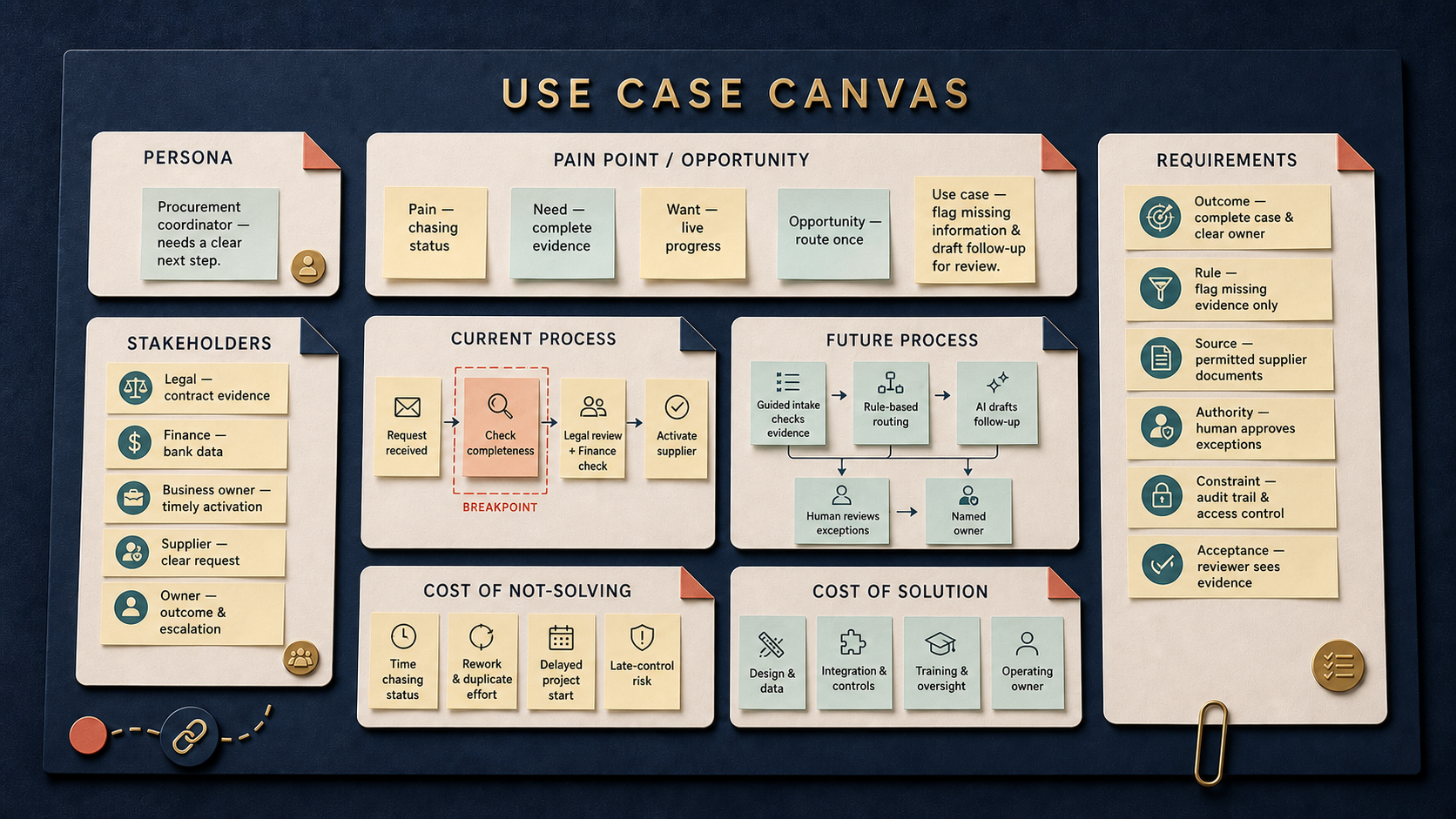
At the end of the journey, Maya is no longer answering a vague question about AI. She can show the steering group a visible chain from a real supplier case to a bounded, governable intervention.
AI-assisted PathPatron illustration, developed under human art direction.
The completed Canvas is not a promise that every case needs an AI solution. It is a shared record of what the team knows, what it still needs to validate, what may change and what must remain under human control.
That record makes a much better steering conversation possible. Maya can say: here is the person caught in the delay; here are the controls we cannot weaken; here is the observable breakpoint; here is the cost of leaving it alone; here is the smallest change worth testing; and here is how we would know it is safe.
Present a finding, not a shiny idea
For leadership, the Canvas replaces a vague “we should use AI” pitch with a traceable account of the decision. It makes the consequence, the evidence, the open questions, the accountable owner and the control boundary visible on one page. Leaders can decide whether the next step deserves time, sponsorship or investment without being asked to approve a tool they have not yet understood.
Turn a use case into a business case
The Canvas is not a financial model, but it gives a business case its grounding. The cost-of-not-solving notes show where time, rework, delay, risk or missed value are occurring; the future-state and solution-cost notes show the change burden required to address them. Maya can then ask a proportionate investment question: is the expected improvement worth the design, data, integration, training, oversight and operating commitment? If the evidence is weak, the next ask may be a short discovery budget—not a delivery commitment.
Work with technical leaders without pretending to be one
For a non-technical leader, the completed Canvas becomes a bridge into technical discovery. Maya does not dictate an architecture or hand over an unstructured wish list. She brings the outcome to achieve, the real workflow, the source information that may be used, the authority that must remain human, the audit and access constraints, and the acceptance evidence. Technical leaders can then translate those business requirements into technical requirements: systems and integrations, data quality and permissions, security controls, evaluation, monitoring, failure handling and operating ownership.
That is a healthier partnership. The business side remains accountable for the problem, value, policy and decision boundary. The technical side remains accountable for whether a safe, reliable implementation exists—and what it would take to run it.
Reference guide: how to use the series
Use this article as the orientation and return to the detailed activity only when the team is ready for that decision:
- Article 2 — People, Stakeholders and Targets: identify the person closest to the consequential moment and the people around it.
- Article 3 — Map Power, Interest and Pain: test the evidence, authority, conflict and non-negotiable boundary.
- Article 4 — From Pain Point to a Real Use Case: write a bounded candidate intervention without selecting technology first.
- Article 5 — Map the Work and the Cost of Not Solving: trace the real route, breakpoints and consequences of delay.
- Article 6 — From Current State to a Credible Future State: compare proportionate options, including their change and control burden.
- Article 7 — Requirements, Evidence and Governance: turn the validated Canvas into a delivery and operating conversation.
The first question is not “which AI tool should we use?” It is the question Maya asked on Thursday afternoon: what happened to this case, and what would a responsible next move require?
Continue the PathPatron Use-Case Canvas
- 1/7: The Monday-Morning Supplier Problem — you are here.
- 2/7: The Supplier Case Has More Than One Owner
- 3/7: From Pain Point to a Real Use Case: Needs, Wants and Opportunities
- 4/7: Map the Work Before You Automate It
- 5/7: The Cost of Not Solving: Making Process Pain Visible
- 6/7: From Current State to a Credible Future State: Cost, Control & Change
- 7/7: Requirements Engineering for AI-Enabled Work: Turn Your Use-Case Canvas into a Delivery Conversation