The Creator's Agent Studio: More Options, Human Direction, Rights-Sensitive Judgement
Agents make creative options nearly free. This briefing helps Creators protect human judgement, rights and credibility while directing a studio of AI agents.
Essays and field notes on trusted AI adoption, sovereign decision-making, governance, vendor risk, and the judgment layer organizations need before implementation moves forward.
Agents make creative options nearly free. This briefing helps Creators protect human judgement, rights and credibility while directing a studio of AI agents.
Organizers can delegate routing, status and escalation to agents without delegating the sequencing, judgement and relationships that keep delivery on track.
An Owner’s evidence is suddenly cheap; their judgement is not. See what agents can prepare, what only an Owner can decide, and how to keep accountability in the right hands.
Products succeed only when Users, Buyers, Deciders and Influencers each have a reason to support them. Prepare an AI initiative in the terms each group needs, not only the cost it promises to reduce.
Technology, Techniques and Terms belong in the same decision. Choose capabilities, practices and guardrails against the value and workflows already mapped.
AI does not repair a broken workflow; it automates its failures faster. Connect measurable value, one transformable process and a paced route from pilot to sustainable operation.
AI adoption is a people decision before it is a tool decision. Map the Targets who determine value and the Transformers who make delivery feasible, then translate between them.
Three different arrangements get called an agent: a constrained assistant, a role-specific suite and a bounded workflow lane. How leaders can tell them apart—and what each demands to run.
Agents take task bundles and workflow lanes, while people retain mandate, judgement and the authority to stop. A practical first inventory for AI-enabled teams.
The CLOUD Act does not care where your server rack stands. The fourth sovereignty question: who can be legally compelled to access your data, models, and systems?
Data crosses networks, borders, and intermediaries on every request. The third sovereignty question: what actually happens to your data in transit?
Encryption at rest means little if someone else holds the keys. The second sovereignty question: who can actually decrypt your data?
Sovereignty breaks at training and inference, not storage. The first question to ask before any sovereign-AI investment: where is your data actually located — and processed?
A practical guide for leaders deciding where a confidential research assistant should operate: Germany, a qualified French component, a controlled European hybrid or a UK boundary.
A practical guide to turning an AI sovereignty decision into a controlled service: local architecture, procurement packages, operating roles and a 30-day plan.
On 2 August 2026, the EU AI Act’s transparency duties became operational. A practical leadership briefing on what applies now, what comes next and how to build evidence-backed controls.
Turn the final requirements area of a Use-Case Canvas into a grounded delivery conversation—without prescribing the solution or surrendering human authority.
Compare credible process improvements—stabilise, automate, assist or use a bounded agentic workflow—by their cost, control and change load.
Turn a mapped workflow into an honest evidence ledger: make time, rework, risk and service impact visible without inventing a false-precision ROI.
Map one real case before choosing automation: make hand-offs, breakpoints, decisions and evidence visible so teams can change the right part of the work.
Turn stakeholder evidence into four concise Pain, Need, Want and Opportunity summaries—then preserve the fuller working record for process mapping.
Use the PathPatron Use-Case Canvas to map the people, evidence and roles around one real workflow before choosing a solution.
A project lead uses one real supplier-onboarding case to turn a vague AI request into an evidence-led, governable next decision.

A practical PathPatron framework for deciding when an AI agent should assist, when workflow automation should run, and where a human must retain authority.

Responsible AI work does not begin when a model cites sources. It begins when an organisation decides which data and sources may enter an AI system, what quality standard they must meet, and who is ac…
Most AI mistakes happen before a prompt is written. The PathPatron Data Boundary Protocol helps teams translate existing data categories into usable AI routes, so everyday work can move with clear bou…
Most AI work fails because the model was never properly briefed. Use the PathPatron One-Page AI Briefing to make the decision, evidence, boundaries and next human action visible before generation begi…
The question for Europe is not whether every model must be open. It is whether its critical institutions still have a meaningful choice when access, terms or geopolitics change.
Prompting is not magic. It is structured thinking: a practical five-part way to give AI the context, task, constraints, examples and output format it needs for useful business work.
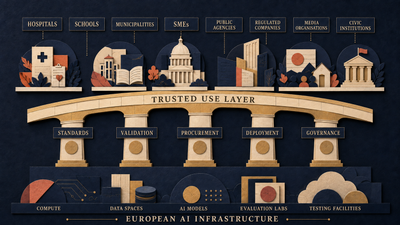
Europe is beginning to fund AI infrastructure, but trusted adoption will not happen automatically. This article argues that the missing middle layer is financing: the standards, validation, procuremen…
Europe already has important building blocks for trusted AI: AI Factories, Testing and Experimentation Facilities, Common European Data Spaces, the European Health Data Space, the European AI Office,…
After TEDxBerlin, one idea stayed with me: Europe's public broadcasting model may offer a useful analogy for AI. Not because broadcasting and AI are the same, but because both raise a structural quest…
Anthropic's Fable 5 and Mythos 5 access restriction is a concrete example of a broader strategic issue: frontier AI is no longer just a technology layer. It is becoming a power layer. For Europe and o…
Sovereign AI is no longer an abstract policy topic. It shows up in regulatory guidance, procurement rules, cloud contracts, and increasingly in ...
The Disruption: The Zero-Click Economy and the Market Shift AI-powered assistants – like Google’s AI Overviews and conversational models such as ChatGPT ...
Artificial intelligence is no longer a science‑fiction novelty. A mid‑2025 PwC survey found that 79 percent of companies already use some form of ...
🔑 Why Techniques Matter for Leaders and Transformation Owners Technology and tools can look great on paper. But if people don’t adopt them, workflows don’t ...
🔑 Why Tools Decisions Matter for Leaders and Decision-Makers Technology is potential. Tools make it usable.AI is just math until you use ChatGPT. Automation ...
🔑 Why Tech Decisions Matter for Leaders and Decision-Makers Artificial Intelligence, automation, BI, and modern data stacks evolve weekly. But products don’t win because ...
AI, automation, and analytics only create lasting impact when you manage the journey—the path from a validated idea to a scaled, reliable ...
Artificial Intelligence, automation, and analytics are only valuable when tied to measurable outcomes across the entire customer journey. That’s what we call ...
Artificial Intelligence, automation, and new digital operating models can feel overwhelming. Tools emerge daily, vendors pitch shiny promises, and leaders are left ...
Artificial Intelligence, automation, and advanced digital systems are exciting on paper — but until someone codes it, integrates it, and keeps it ...
Artificial Intelligence, automation, and digital technologies can reshape industries — but none of it matters unless someone actually builds, tests, and sustains ...
Artificial Intelligence, automation, and advanced tooling can spark incredible innovation. But what happens the day after launch? Who ensures that the system ...
Artificial Intelligence, automation, and digital systems can scale faster than ever — but scale without credibility collapses. That’s why Testers matter. Testers ...
Artificial Intelligence, automation, and digital transformation don’t just change how products are built — they also change how decisions get made. Not ...
Artificial Intelligence, automation, and new digital models are changing how products are purchased and funded. But here’s the reality: your product doesn’t ...
🔑 Why Deciders Matter Every product initiative eventually reaches a crossroads: someone with authority must approve or block it. These are your ...
🔑 Why Users Still Come First Artificial Intelligence, automation, and other emerging technologies are reshaping products — from automating repetitive workflows to ...
Signals, practical tools, and decision frameworks for leaders navigating AI adoption.
Double opt-in. Unsubscribe any time.